Uecht: The Swiss Hill With a Remarkable Astronomy Story
From a small private observatory to Switzerland's Space Eye science centre, this peaceful hill near Bern has a history worth knowing.

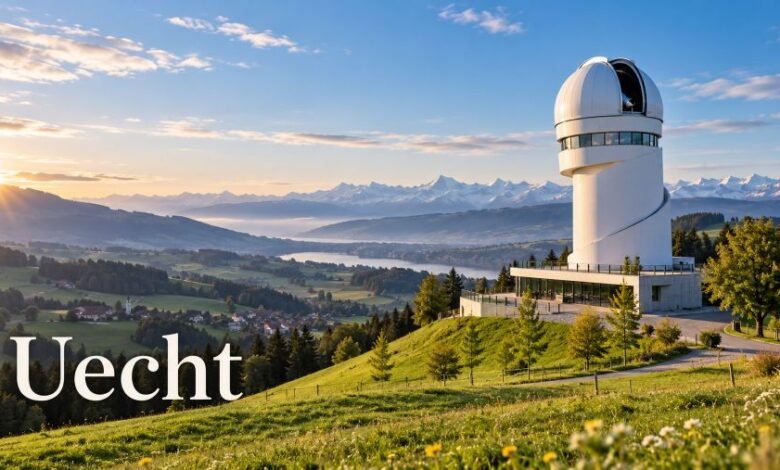
Uecht is a hill near Niedermuhlern in Switzerland. It sits roughly 950 metres above sea level. At first glance, it looks peaceful. Green fields stretch across the landscape. Small roads connect nearby villages.
But there is something unusual here.
Uecht has a long connection with astronomy. A private observing station opened in 1951. Today, the hill is home to Space Eye, a public observatory with a large telescope, an 8K planetarium, and exhibitions about space and the environment.
The name has other meanings, too. It appears in German art history and Luxembourgish place names.
So, what makes this place special? Here are the facts.
Quick Facts
| Detail | Information |
|---|---|
| Name | Uecht |
| Location | Niedermuhlern, Canton of Bern |
| Country | Switzerland |
| Elevation | Approximately 950 metres |
| Known for | Astronomy and astronomical observation |
| First observing station | 1951 |
| Original founder | Willy Schaerer |
| Modern observatory | Space Eye |
| Modern centre opened | September 2023 |
| Building architect | Mario Botta |
| Main telescope mirror | 101 centimetres |
| Planetarium | 8K digital projection |
| Official website | space-eye.ch |
A Quiet Location Near Bern
The hill lies south of Bern. It forms part of the Längenberg area. The surrounding countryside is largely rural.
That location matters for astronomy.
Bright city lights can hide faint stars. Astronomers call this problem light pollution. Clouds and fog can also interrupt observations.
Uecht offered a useful alternative.
Its elevated position puts it above some of the winter fog affecting lower areas. The site is also away from the brightest city centres.
Those conditions attracted Willy Schaerer, a Swiss engineer and businessman with an interest in astronomy.
He saw real possibilities there.
The hill eventually became a recognised location for astronomical work. Its connection with astronomy continues through the modern facilities operating there today.
How the Astronomy Story Began
The story starts in 1951.
Willy Schaerer established a private astronomical observing station on the hill. His aim was to study the night sky from a location with favourable viewing conditions.
The project gradually grew.
In 1965, a replacement observatory was built. New equipment and facilities followed over the years.
One important moment arrived in 1974.
Astronomer Wilhelmine Burgat discovered Supernova 1974G. She later became head of the observatory.
A supernova is a powerful stellar explosion. Observing these events helps astronomers study how stars change and die.
That discovery became part of the observatory’s documented scientific history.
The station also supported astronomical research. It served as a useful complement to the University of Bern’s Zimmerwald Observatory.
Public access came later.
Guided visits began in 1993. People could now learn about astronomy through organised activities.
The original private project had become something bigger.
Important Dates in Its Development
Here is a quick look at the main events.
| Year | Event |
|---|---|
| 1951 | Willy Schaerer established the first observing station |
| 1965 | A replacement observatory was constructed |
| 1974 | Wilhelmine Burgat discovered Supernova 1974G |
| 1976 | A workshop extension was built |
| 1982 | The Privatsternwarte Uecht foundation was established |
| 1993 | Public guided visits began |
| 1996 | The workshop became a training room |
| 2000 | Existing astronomical instruments received technical improvements |
| 2013 | Preparations advanced for expanding the observatory |
| 2019 | The Space Eye construction project broke ground |
| 2023 | Space Eye opened to visitors |
| 2026 | The historic Schaerer observatory reopened following renovation |
These dates follow the official Space Eye historical records and facility updates.
The Arrival of Space Eye
A major change came in 2023.
The Space Eye Observatory for Space and the Environment opened to the public in September.
Its purpose was simple.
Make astronomy accessible to more people.
The new centre combines scientific instruments with educational activities. Visitors can learn about planets, distant stars, space missions, and environmental issues.
The building also looks unusual.
Swiss architect Mario Botta designed its striking tower. Its white, layered exterior stands out against the surrounding countryside.
Inside, the equipment tells another story.
There is a large astronomical telescope. A digital planetarium provides simulated views of space. An exhibition explains how scientific research connects with life on Earth.
The result is a visitor attraction with a real research heritage.
Inside the Modern Observatory
The Main Astronomical Telescope
The telescope is a major attraction.
Space Eye describes it as Switzerland’s largest telescope. Its main mirror measures 101 centimetres across.
Why does that matter?
Large mirrors collect more light. This makes it easier to observe faint objects.
The telescope can help visitors see planets, stars, and other celestial objects. What they can actually observe depends on weather, visibility, and the scheduled programme.
Clear skies make a difference.
If clouds cover the sky, direct astronomical viewing may not be possible.
The Digital Planetarium
The centre also has an 8K planetarium.
It uses a large dome to display images of space. Visitors can watch presentations about stars, planets, and the wider universe.
The dome measures 10 metres across.
According to its technical information, the theatre has approximately 80 seats and uses six Canon laser projectors.
The planetarium works during daylight, too.
That makes it useful when outdoor observation is impossible.
Visitors can still learn about astronomy even if the weather changes.
Space and Environmental Exhibitions
There is more than astronomy here.
The exhibition explains how people study space and Earth. Topics include satellites, Earth observation, space debris, and human activity beyond our planet.
One exhibit concerns the Automated Transfer Vehicle, or ATV.
This European spacecraft type was used to carry supplies to the International Space Station.
The exhibits connect scientific ideas with actual space technology.
That makes the centre useful for families, school groups, and visitors interested in science.
The Historic Observatory Still Matters
New buildings often replace old ones.
That did not happen here.
The historic Schaerer observatory remains part of the site. Its original instruments and displays help explain the area’s scientific past.
The building underwent renovation in 2026.
Space Eye reports that visitors can once again see the historic observatory through its self-guided exhibition programme.
The renovation also provided new working spaces.
There is another project being discussed.
The organisation has announced plans to renovate Willy Schaerer’s former house in 2027. The proposed work includes accommodation and office space.
For now, that remains a planned development.
The main point is clear: the historic buildings are still part of the observatory’s identity.
Another Astronomy Site Nearby
There is another interesting scientific facility.
The Sonnenturm Uecht is a privately operated solar observatory in the Niedermuhlern area.
Its work focuses on the Sun.
The facility uses specialised telescopes and instruments to observe solar activity in different wavelengths of light.
It also operates weather-monitoring equipment and cameras.
Unlike ordinary stargazing, solar observation requires specialised filters and safe instruments. Looking directly at the Sun through an unfiltered telescope is dangerous.
The solar observatory is separate from Space Eye. Its work adds another scientific connection to the area.
Can Tourists Visit?
Yes, visitors can experience Space Eye.
But planning matters.
The observatory does not operate like an ordinary attraction with continuous walk-in hours.
Public visits follow scheduled programmes. Private tours and group visits can also be booked.
Available experiences include daytime exhibitions, planetarium presentations, and evening astronomy sessions.
An evening visit may include telescope observation.
Weather still controls the view.
Published Ticket Prices
The official ticket page lists these adult prices:
| Programme | Adult price |
|---|---|
| Journey | CHF 39 |
| Stargaze | CHF 49 |
| Night Sky Explorer | CHF 52 |
| Self-guided exhibition | CHF 22 |
Reduced prices are offered for eligible children and other visitor groups.
These were the published prices checked in October 2026. Visitors should confirm the latest charges before booking.
Getting There
The observatory’s address is:
Space Eye Observatory, Uecht 53a, 3087 Niedermuhlern, Switzerland.
Visitors travelling from Bern can use public transport to Niedermuhlern.
From the village, they can walk to the observatory or use the shuttle during applicable programmes.
The scenic walking trail takes approximately 45 minutes. A shorter direct route takes around 25 minutes.
Private vehicle parking is generally arranged in Niedermuhlern. Parking beside the observatory is restricted to visitors with the appropriate mobility parking permit.
The official website provides updated transport information.
What Does the Name Mean?
The word does not have one meaning everywhere.
In Switzerland, it identifies the geographical location associated with the observatory.
But similar forms also appear elsewhere in Europe.
A historical German artists’ group used the spelling Üecht, with an umlaut. Its name was associated with dawn or early morning.
In Luxembourgish place-name research, Uecht has another possible linguistic origin.
University of Luxembourg researchers connect the regional term with Middle High German words associated with particular kinds of landholding.
These are different historical contexts.
There is no good reason to assume that every use of the name comes from exactly the same word or origin.
The Artists Who Used a Similar Name
A group of German artists adopted the name Üecht in Stuttgart in 1919.
This was a period of change.
The First World War had ended. Artists were questioning traditional teaching methods and established styles.
Willi Baumeister and Oskar Schlemmer were among the group’s founders.
They were interested in new artistic ideas.
The association maintained links with Berlin’s Novembergruppe. Its members wanted reforms in art education and supported experimental artistic work.
The group’s exhibitions attracted attention.
Its first autumn exhibition took place in 1919, followed by another in 1920.
Art-history sources connect the word Üecht with the idea of dawn. For those artists, that meaning suggested a new beginning.
The group belongs to German modern-art history.
It should not be confused with the Swiss observatory or the hill near Bern.
Why This Small Place Attracts Attention
Many places are known for scenery.
This one has something else.
It connects generations of astronomical interest.
The original station began with one person’s curiosity. Over time, it gained scientific equipment, research connections, and public activities.
Today’s observatory continues that work.
Visitors can see the equipment. They can learn about the night sky. They can also find out how space research relates to conditions on Earth.
The historic building adds context.
It reminds visitors that serious astronomical work existed here long before the modern centre opened.
And the location still helps.
Its relatively rural setting offers viewing opportunities that would be harder to find in the middle of a brightly lit city.
What Has Changed in 2026?
The main verified development concerns the historic observatory.
Following renovation, the Schaerer building is again accessible through the visitor programme.
Space Eye also continues to offer educational events, astronomy presentations, and scheduled observation activities.
Its official news archive records public activities during 2026, including astronomy-related events and presentations.
The proposed 2027 renovation of the founder’s former house is another development to watch.
There is no need to guess what comes next.
The organisation publishes its plans and visitor information through its official website.
Frequently Asked Questions
1. What is Uecht?
It is a hill near Niedermuhlern in Switzerland. The location is particularly known for its astronomical observatories.
2. Where is it located?
It lies in the Canton of Bern, south of the Swiss capital, in the Längenberg area.
3. Who founded the original observatory?
Swiss engineer and businessman Willy Schaerer established the first private observing station in 1951.
4. What is Space Eye?
Space Eye is a public observatory and science education centre. It includes a large telescope, planetarium, and exhibition facilities.
5. When did the new centre open?
Space Eye opened to the public in September 2023.
6. Can visitors use the telescope?
Visitors can take part in programmes featuring telescope observation. Actual viewing depends on weather conditions and programme arrangements.
7. Is visiting free?
Most public experiences require tickets. Prices depend on the programme and visitor category. Children aged six and under may receive free admission under the operator’s ticket conditions.
8. What is special about its history?
Astronomical observation began here in 1951. The site also records the 1974 discovery of Supernova 1974G by Wilhelmine Burgat.
9. Does the name have another meaning?
Yes. Üecht was also the name of a German artists’ association founded in 1919. A related spelling appears in Luxembourgish place names.
10. Is the historic observatory open in 2026?
Yes. Space Eye states that the historic Schaerer observatory reopened to visitors following renovation in 2026, through the relevant exhibition programme.
Final Thought
Uecht looks like a quiet hill.
Its history tells another story.
Astronomers have worked here since 1951. Their activities brought discoveries, scientific instruments, and educational opportunities to a small Swiss location.
Today, Space Eye gives the public a chance to learn about that history while seeing modern astronomy equipment.
The place remains peaceful.
But above those green fields, there is a much bigger story waiting in the night sky.