Seneca Learning: How It Works, Features, Courses and Pricing in 2026
A clear look at Seneca Learning, its free revision courses, Premium tools, teaching features, company history and benefits for students.

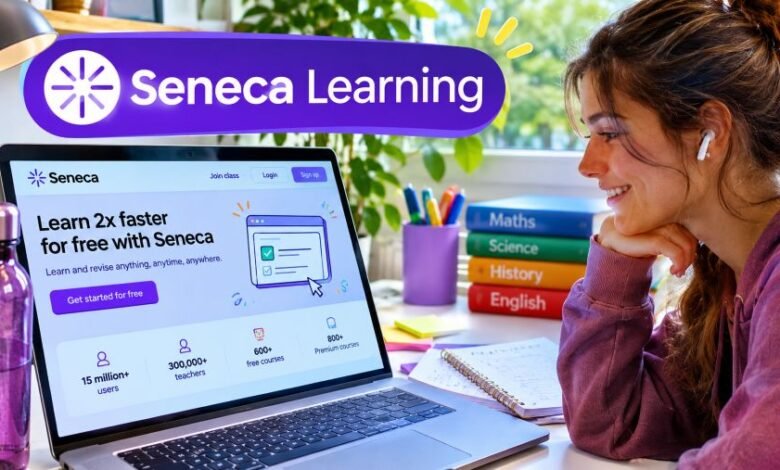
Studying can feel tiring. Especially before big exams.
Students often spend hours reading textbooks. Yet remembering everything is another story.
That’s where Seneca Learning comes in.
This UK-based learning platform offers interactive revision, practice questions and automatic feedback. Students can study at their own pace, while teachers can assign homework and check results.
Many courses are free. Paid options offer extra tools.
But how does Seneca actually work? And is it worth using in 2026?
Here is what you should know.
What Is Seneca Learning?
Seneca Learning is an online education platform. It mainly helps school students revise subjects and prepare for exams.
The platform offers short lessons followed by interactive questions. Students answer questions, receive feedback and revisit topics they find difficult.
It’s a simple idea.
Instead of reading the same notes repeatedly, students practise recalling what they have learned.
Seneca also supports teachers. They can assign homework, review scores and check which students need extra attention.
Parents can follow their child’s progress through a separate account.
The platform is widely used for UK qualifications, including GCSE and A-Level courses.
Seneca Learning Quick Facts
| Detail | Information |
|---|---|
| Name | Seneca Learning |
| Company name | Seneca Learning Ltd |
| Industry | Education Technology |
| Incorporated | 16 September 2016 |
| Platform launched | 2017 |
| Country | United Kingdom |
| Registered office | London, England |
| Company number | 10379489 |
| Main services | Online revision and homework |
| Main users | Students, teachers and parents |
| Courses | 600+ free exam-board-specific courses |
| Premium content | 800+ additional courses |
| Reported users | 15 million+ worldwide |
| Reported teachers | 300,000+ |
| Business model | Free and paid subscriptions |
| Acquiring company | GoStudent, in 2022 |
| Official website | senecalearning.com |
The user figures are published by Seneca itself and may change.
How Does Seneca Learning Work?
Using the platform is straightforward.
Students start by creating an account. They can then choose their school level, subject and relevant course.
Lessons break topics into smaller sections.
After reading the explanation, students answer questions that test their understanding.
Some questions check basic knowledge. Others ask students to remember earlier material.
Feedback appears during the learning process.
This makes mistakes easier to spot.
Students can repeat sections and review topics they have not fully understood.
Seneca also uses learning data to recommend revision activities in certain modes.
The aim is to make study sessions more focused.
How to Start Using Seneca
Getting started takes only a few steps.
- Visit the official Seneca Learning website.
- Create a free student account.
- Choose your education level.
- Select a subject and course.
- Start a revision session.
- Complete the questions.
- Review your scores and weaker topics.
Teachers can also invite students to join classes and complete assigned work.
What Subjects Does Seneca Learning Cover?
Seneca offers courses across several school levels.
Its main focus is UK education, particularly Key Stage 3, GCSE and A-Level study.
Popular subjects include:
- Mathematics
- English Language
- English Literature
- Biology
- Chemistry
- Physics
- History
- Geography
- Business
- Computer Science
- French
- Spanish
- Psychology
Course availability depends on the student’s qualification, level and exam board.
Seneca also provides selected international learning content, including iGCSE and other curricula.
Students should check their exact course before beginning revision.
This matters. Exam requirements can differ.
Main Features of Seneca Learning
Seneca includes several tools for independent study and classroom homework.
Some are free. Others require Premium access.
Interactive Revision Lessons
Seneca uses shorter learning sections instead of long textbook chapters.
Students read an explanation and answer questions as they move through the course.
This keeps revision active.
It’s especially useful for checking basic understanding before attempting longer exam questions.
Smart Learning Mode
Smart Learning Mode uses previous learning activity to recommend what students should study.
The recommendations develop as students complete more work.
This can help students revisit material rather than always choosing familiar topics.
Access depends on the available subscription features.
Practice Questions
Practice questions are a major part of Seneca.
Students answer questions throughout their courses and receive feedback.
The questions encourage active recall.
Still, students preparing for written examinations should practise full exam papers as well.
Premium Revision Modes
Premium subscriptions offer extra study options.
These include specialist revision modes, advanced questions and other tools depending on the selected package.
Students should check the current package details before paying.
AI-Marked Exam Questions
Seneca offers AI-supported marking for certain exam-style questions.
Students can receive feedback without waiting for every answer to be checked manually.
That’s useful for extra practice.
However, automated marking should not be treated as an official examination grade.
Amelia AI Assistant
Amelia is Seneca’s AI learning assistant.
It can answer study questions and explain topics based on a student’s learning level.
The assistant is offered through an eligible paid subscription.
Students should still check important answers against course material and teacher guidance.
Progress Tracking
Students can review their activity and performance.
Teachers also have access to reporting tools that show completed assignments, scores and knowledge gaps.
This helps identify topics needing more work.
Is Seneca Learning Free?
Yes. Seneca provides a free learning platform.
Its free courses cover many UK school subjects and exam boards.
Students can access standard revision material without purchasing Premium.
Teachers can also use free assignment and marking tools.
But paid subscriptions offer additional content and study features.
Seneca Learning Free vs Premium
| Free Seneca | Seneca Premium |
|---|---|
| Free revision courses | Additional Premium courses |
| Interactive questions | Specialist revision modes |
| Standard learning activities | Extra exam practice tools |
| Basic progress information | More advanced learning features |
| Free teacher homework tools | Paid features depend on package |
Seneca’s official help centre lists more than 600 free courses and over 800 Premium courses.
How Much Does Seneca Premium Cost?
Seneca offers different subscription packages.
Students can choose from payment terms such as monthly, seasonal and annual subscriptions.
Its documented student options include Exam Boost and Amelia AI Assistant packages.
An optional Grade Guarantee is also advertised.
Seneca’s help centre lists the Grade Guarantee add-on at £5.99 per month.
Exact Premium subscription prices are shown during package selection and can change.
Always check the latest checkout price before purchasing.
How Teachers Use Seneca Learning
Seneca is not limited to independent revision.
Teachers use it for classroom assignments and homework.
They can select a course, choose the relevant sections and set work for students.
Many assignments are marked automatically.
This saves time on routine marking.
Teachers can then review results and identify topics students are struggling with.
The platform’s Insights tools provide information about student activity, grades and knowledge gaps.
Schools can purchase extra services for reporting and administration.
How Parents Can Monitor Learning
Parents can also use Seneca.
The parent platform lets them view their child’s study activity and assignment progress.
Reports include study time, average scores and completed work.
Parents can check information by week, month and subject.
This can help families understand whether revision is happening regularly.
Yet scores need context.
A high score on a short quiz does not always mean a student is fully ready for an exam.
Who Founded Seneca Learning?
Seneca Learning was established as a UK education business in 2016.
Its official company history identifies 2017 as the year the platform launched.
Stephen Wilks was publicly identified as a co-founder and CEO.
Lukas Feddern was also part of the company’s early leadership and ownership.
Both individuals previously served as company directors.
According to UK Companies House records, they resigned from their director positions on 7 February 2024.
Who Owns Seneca Learning?
GoStudent announced its acquisition of Seneca Learning on 2 February 2022.
GoStudent is an education technology company known for online tutoring services.
The acquisition brought Seneca’s learning content into GoStudent’s wider education business.
At the time, GoStudent said the acquired businesses would continue operating under their established brands.
The full current ultimate shareholding structure cannot be established from the basic Companies House overview alone.
Seneca Learning Company Information
Seneca Learning Ltd is registered in England and Wales.
Its company registration number is 10379489.
The business was incorporated on 16 September 2016 and remains listed as active.
Its registered office is at 123 Buckingham Palace Road, London, SW1W 9SH, England.
Companies House records identify Matthew James Read as a director, appointed on 8 December 2025.
This confirms his registered position. It does not independently establish a current CEO title.
Does Seneca Learning Help Students Get Better Grades?
Seneca promotes an educational study involving 1,120 students.
According to the company, students using its platform achieved test scores 105% higher than a comparison group using traditional revision methods after approximately four weeks.
That is a striking figure.
But it needs context.
The result relates to a particular research study. It does not mean every student will double their GCSE grades or achieve the same improvement.
Actual results depend on study habits, subject knowledge, teaching and exam preparation.
Seneca can support learning, but students should also use past papers and teacher feedback.
Benefits of Seneca Learning
One big benefit is accessibility.
Students can start using many courses without paying.
The short lessons also make revision easier to manage during a busy school week.
Interactive questions encourage students to check what they remember.
Teachers benefit from automatic marking and progress reports.
Parents can follow learning activity too.
For students who struggle to organise revision, structured courses can provide a useful starting point.
Limitations of Seneca Learning
Seneca has some limitations.
Not every learning feature is free.
Some students may need more detailed explanations than short lessons provide.
Automated answers and marking can also have limitations, especially with complex written responses.
The platform cannot replace practical experiments, classroom discussion or detailed essay feedback.
And course coverage varies.
Students taking less common qualifications should confirm that their required syllabus is available.
Basically, Seneca works best as part of a wider revision routine.
Is Seneca Learning Safe and Legitimate?
Seneca is a registered UK education company with an established online platform.
It publishes official company and support information.
Students, teachers and parents can create different account types.
As with other online education services, users should understand how their information is collected and handled.
Parents should read the privacy policy before registering younger children.
Paid users should also check subscription renewal and cancellation terms.
These details matter, especially before entering payment information.
Can Students Use Seneca Learning Outside the UK?
Seneca serves learners outside the United Kingdom.
Its international content includes selected courses for qualifications such as iGCSE.
However, available subjects and features may differ by country.
Students outside the UK should check whether their required examination board is supported.
For example, a student preparing for Cambridge international examinations should choose content matching the correct syllabus.
A UK GCSE course may not cover every requirement of another qualification.
Seneca Learning vs Traditional Revision
Traditional revision often involves textbooks, handwritten notes and practice papers.
Seneca takes a different approach.
Students study short explanations and answer questions during the same session.
This makes it easier to check understanding immediately.
But both methods have value.
Textbooks can provide greater detail. Past papers help students practise examination timing and written answers.
Seneca is useful for regular recall practice.
A sensible study plan can combine these methods rather than relying entirely on one resource.
Who Should Use Seneca Learning?
Seneca may suit several types of learners.
Students preparing for GCSE and A-Level examinations can use it for regular practice.
Younger students can work through supported school subjects.
Teachers can set homework and review class performance.
Parents can monitor learning and encourage regular revision.
Home educators may also find the structured courses useful.
Still, the right choice depends on the student’s curriculum and learning needs.
Final Thought
Seneca Learning offers a practical way to revise school subjects online.
Its free courses make it accessible to many students, while paid tools provide extra practice and AI-supported features.
The platform has grown from a UK education project into a learning service used internationally.
Its biggest strength is simple.
Students can learn, answer questions and check their progress in one place.
But good exam preparation needs more.
Regular study, past-paper practice and support from teachers still matter.
For students whose courses match the available content, Seneca can be a useful part of their everyday revision.
Frequently Asked Questions
1. What is Seneca Learning used for?
Seneca Learning is used for online revision, homework and exam preparation. It offers interactive courses, practice questions and progress tracking.
2. Is Seneca Learning free?
Yes. Seneca offers hundreds of free courses. Premium subscriptions provide extra learning tools and content.
3. Who founded Seneca Learning?
Stephen Wilks is a publicly identified co-founder. Lukas Feddern was also involved in the company’s early leadership and ownership.
4. When was Seneca Learning established?
Seneca Learning Ltd was incorporated in September 2016. The platform officially launched in 2017.
5. Who owns Seneca Learning?
GoStudent announced the acquisition of Seneca Learning in February 2022.
6. Is Seneca Learning good for GCSE revision?
It offers GCSE courses and interactive practice questions. Students should also use past papers and other course materials.
7. Does Seneca Learning offer A-Level courses?
Yes. Seneca provides A-Level revision courses across several subjects.
8. Does Seneca Learning use AI?
Yes. Certain paid features include AI-supported marking and Amelia, an AI study assistant.
9. Can teachers use Seneca for free?
Yes. Teachers can create classes, assign standard homework and review student progress using free features.
10. Can Seneca Learning guarantee better grades?
No platform can guarantee better results for every student. Seneca reports positive research findings, but individual outcomes vary.