Patsy Rodenburg: How Her Voice Work Shaped Modern Acting
The London-born teacher has spent decades working with actors, Shakespeare and the human voice. In 2026, she remains active at the Royal Shakespeare Company.

Introduction
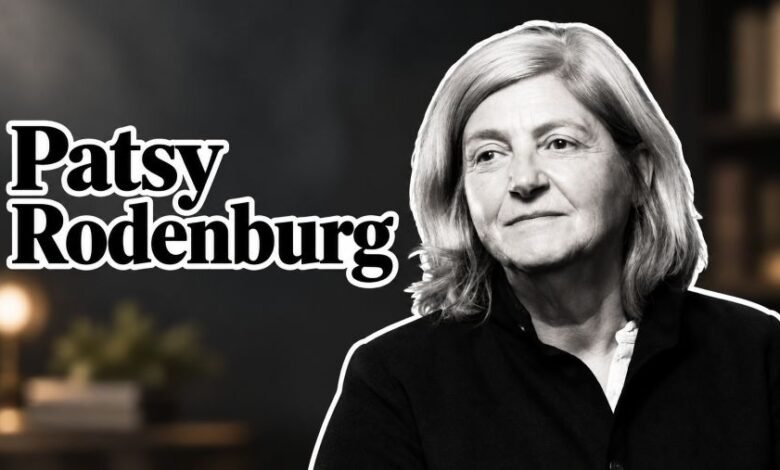
Patsy Rodenburg OBE is a British voice and acting coach, teacher and author whose career has stretched across some of the biggest names in British theatre.
Her work is closely tied to Shakespeare.
So is actor training.
She has worked with the Royal Shakespeare Company, founded the Voice Department at the National Theatre and spent more than four decades connected with the Guildhall School of Music & Drama.
Right now, her work continues.
As of September 2026, Rodenburg is the Royal Shakespeare Company’s Emeritus Director of Voice. The honorary role was announced in 2025.
She also received the Pragnell Shakespeare Birthday Award in 2026.
That makes her current story quite clear. She is not simply a figure from an earlier period of British theatre. She is still teaching, advising and working on voice.
Quick Facts About Patsy Rodenburg
| Fact | Detail |
|---|---|
| Full professional name | Patricia Anne Rodenburg |
| Known as | Patsy Rodenburg |
| Born | 1953 |
| Birthplace | London, England |
| Nationality | British |
| Profession | Voice and acting coach, teacher and author |
| Current role | RSC Emeritus Director of Voice |
| RSC role started | 2025 |
| Major former workplace | Guildhall School of Music & Drama |
| National Theatre work | Founded its Voice Department in 1990 |
| Honour | OBE, awarded in 2005 |
| Teaching recognition | National Teaching Fellow, 2011 |
| 2026 award | Pragnell Shakespeare Birthday Award |
| Known for | Voice training, Shakespeare, presence and the Three Circles of Energy |
| Latest major book | The Woman’s Voice, 2023 |
Who Is Patsy Rodenburg?
Patsy Rodenburg is best known as a voice teacher.
But that description is quite broad.
Her work covers breath, speech, physical presence, text, listening and the way an actor communicates with an audience.
Shakespeare sits near the centre.
For decades, actors have worked with her on how language sounds and feels when spoken aloud. The point is not simply volume. It is connection.
Her official profile says she has worked with actors including Judi Dench, Ian McKellen, Daniel Day-Lewis, Nicole Kidman, Daniel Craig and Hugh Jackman.
She has also worked outside acting.
Her teaching has reached teachers, business leaders and other people whose professional lives depend on speaking clearly and connecting with listeners.
Early Life in London
Rodenburg was born in 1953.
She was born and raised in London.
Interestingly, speaking did not come easily to her as a child.
Published accounts of her early life say she struggled with communication from a young age. She later connected that experience with her decision to work with the human voice.
That detail matters.
Her career did not start from an assumption that speaking well comes naturally to everyone. Her teaching grew partly from trying to understand fear, breath and communication herself.
Voice Training and Education
In 1973, Rodenburg began studying voice at London’s Central School of Speech and Drama.
There she studied with Gwyneth Thurburn.
Her training continued after Central.
She spent around five and a half years apprenticing with voice teacher Sheila Moriarty, according to a detailed academic study of her work published in Voice and Speech Review.
Then came a major career change.
In 1981, Cicely Berry and Trevor Nunn brought her to the Royal Shakespeare Company.
Berry was already one of the best-known figures in theatre voice work.
Rodenburg worked alongside her for nine years.
That period tied Rodenburg closely to classical theatre and Shakespeare.
Patsy Rodenburg and the Royal Shakespeare Company
Her first long period with the RSC started in 1981.
She spent nine years working with the company.
Decades later, the relationship returned in a new form.
In October 2025, the RSC appointed her Emeritus Director of Voice.
The position is honorary and unpaid.
Her work includes advising the company on voice training and helping with programmes for actors, teachers and other professionals.
The role remains current in 2026.
In fact, the RSC credits Rodenburg alongside Paula Stephens for voice work on its 2026 production of As You Like It.
So the connection is active.
Not ceremonial only.
More Than Four Decades at Guildhall
Rodenburg also built a very long career at the Guildhall School of Music & Drama.
She joined Guildhall in 1981.
Bloomsbury records her service as Head of Voice from 1981 to 2016. She later held the position of Professor of Text and Poetry.
Her association with the school lasted more than four decades.
During that time, she taught actors how to work with voice, speech, poetry and dramatic text.
Many later became well-known performers.
This period became one of the main parts of her professional life.
Why Did Patsy Rodenburg Leave Guildhall?
Her Guildhall departure drew public attention in 2024.
Rodenburg argued that some traditional acting skills were receiving less attention than they needed.
She spoke particularly about breath.
Voice mattered too.
So did body work, text and Shakespeare.
Her concern was that actors need serious technical training before they can depend on those skills under the pressure of live performance.
Guildhall did not accept every part of her criticism.
The school said Shakespeare and classical training still remained within its programme.
So this was a public disagreement about how actors should be trained, rather than a simple one-sided story.
After leaving, Rodenburg kept teaching independently.
Then the RSC appointed her to its emeritus voice position the following year.
Founding the National Theatre Voice Department
Another major career point came in 1990.
Richard Eyre asked Rodenburg to set up the Voice Department at Britain’s National Theatre.
She did.
Rodenburg then led voice work there for around 16 years.
This gave her a direct role in preparing professional performers for large-scale theatre.
Actors working in such spaces need stamina.
They need clear speech too.
And they must carry language through a theatre without losing emotional connection.
Those problems sit right inside Rodenburg’s teaching.
What Is Patsy Rodenburg’s Second Circle?
One of the ideas most closely linked to Rodenburg is the Three Circles of Energy.
The best-known part is Second Circle.
Basically, the circles describe different ways people direct and receive energy while communicating.
First Circle turns inward.
A person may become withdrawn or disconnected from the other person.
Third Circle pushes strongly outward.
That can feel forceful, but genuine listening may disappear.
Second Circle is the exchange.
You speak.
You listen.
You respond.
The other person affects you.
For Rodenburg, this state of presence is especially useful for actors because performance depends on real contact with another actor, the text and the audience.
The idea later reached people outside theatre as well.
How Her Voice Training Works
Rodenburg’s teaching connects physical and verbal work.
A common sequence in descriptions of her practice is:
body → breath → voice → speech → text
That order says a lot.
An actor cannot simply start with the words and hope everything else works.
Breathing matters.
The body matters.
Speech needs physical support.
Then the actor can deal with language.
Her Shakespeare teaching follows the same practical thinking. Rhythm, consonants, vowels, pauses and changes in thought are treated as useful information inside the text.
Actors still make choices.
But they first look closely at what the playwright has given them.
Books by Patsy Rodenburg
Writing has carried her teaching beyond rehearsal rooms.
Her main books include:
- The Right to Speak — first published in 1992, revised edition in 2015
- The Need for Words — first published in 1993, revised edition in 2018
- The Actor Speaks — 1997, second edition in 2019
- Speaking Shakespeare — later issued in a second edition in 2023
- Presence — 2009
- Power Presentation — 2009
- The Woman’s Voice — 2023
The subjects change from book to book.
Some are aimed closely at actors.
Others deal with everyday speaking, presence and communication.
The Woman’s Voice takes a more personal route. It connects Rodenburg’s work on breath and speech with questions about how women are heard.
Awards and Recognition
Rodenburg was appointed an Officer of the Order of the British Empire, or OBE, in 2005 for her contribution to drama.
In 2011, she became a National Teaching Fellow.
Then came another major recognition.
In 2026, the Royal Shakespeare Company announced her as the recipient of that year’s Pragnell Shakespeare Birthday Award.
The prize recognises work that has helped people understand and enjoy Shakespeare.
For Rodenburg, it fitted closely with decades spent teaching actors how to speak classical text.
Patsy Rodenburg’s Work in 2026
Rodenburg remains professionally active.
Her RSC position continues.
Her academy also runs voice, presence and teacher-training work.
The Patsy Rodenburg Associate programme trains teachers in her approach, with further programme dates already listed for 2027.
Her current RSC work is easy to see too.
The company’s 2026 As You Like It credits list Patsy Rodenburg and Paula Stephens for voice.
That production runs at the Royal Shakespeare Theatre from 26 September to 7 November 2026.
So, yes, she is still working directly around performance.
Why Her Work Is Still Discussed
Voice training can sound technical.
Sometimes it is.
But Rodenburg’s basic question is simple: can a speaker fully connect with another person while using their voice freely?
Actors face that question every night.
A Shakespeare speech can be dense. A large theatre can be demanding. Emotion may change breath and rhythm.
Training gives the actor something reliable underneath all that.
This explains why Rodenburg has spent so much of her career talking about craft.
The goal is not to make every actor sound the same.
It is to give them enough control to make clear choices.
Final Thought
Patsy Rodenburg has spent more than five decades working with voice, actors and spoken text.
Her career links several major British theatre institutions: the Royal Shakespeare Company, National Theatre and Guildhall School of Music & Drama.
The work continues today.
Her 2025 RSC appointment and 2026 Pragnell Shakespeare Birthday Award make that especially clear.
For readers trying to understand why her name appears so often in discussions about acting, Shakespeare and voice training, the answer is simple: teaching actors how to speak, listen and remain present has been the centre of her professional life.
Frequently Asked Questions
Who is Patsy Rodenburg?
Patsy Rodenburg OBE is a British voice and acting coach, teacher and author known for her work with actors, Shakespeare and professional voice training.
What does Patsy Rodenburg do now?
As of September 2026, she is the Royal Shakespeare Company’s Emeritus Director of Voice and continues teaching through her own academy.
When was Patsy Rodenburg born?
She was born in 1953 and was raised in London.
What is Patsy Rodenburg’s Second Circle?
Second Circle is her term for a state of active presence where a person both sends and receives energy while communicating.
Did Patsy Rodenburg work at the National Theatre?
Yes. She founded its Voice Department in 1990 and led voice work there for around 16 years.
How long did Patsy Rodenburg work at Guildhall?
Her association with the Guildhall School of Music & Drama lasted more than four decades, beginning in 1981.
Which actors has Patsy Rodenburg worked with?
Her official profile names actors including Judi Dench, Ian McKellen, Daniel Day-Lewis, Nicole Kidman, Daniel Craig and Hugh Jackman.
What award did Patsy Rodenburg receive in 2026?
She received the 2026 Pragnell Shakespeare Birthday Award for her contribution to the understanding and performance of Shakespeare.