A camera mounted near the house may show the garage, the first section of the drive, and a clear view of the front walk. Then a car turns in from the far end or a person crosses toward the side gate, and the subject slips out of the frame.
A fixed camera works well when one stable view covers the activity that matters. A pan-tilt camera makes more sense when movement travels across a wide area and one lens cannot hold the entire route at once. The sections below explain where each design fits, what tracking adds, and how to choose without treating either option as the universal answer.
Alt: A long residential driveway monitored by a house-mounted eufy TrackLight Cam S1
What Should You Check before Comparing Camera Types?
Walk the route a person or vehicle actually takes from the street to the house. Note where the subject first appears, where it moves sideways, and which areas still matter after it reaches the door or garage.
- Is the driveway short enough for one fixed frame to show the entrance and the stopping point?
- Does the yard widen to one side, creating a crosswise path outside a fixed view?
- Do you already have a fixed camera covering the house and need a second view farther out?
- Would losing sight of one area while a camera follows movement create a problem?
These questions set the boundary for the comparison. The next sections start with the strengths of a fixed camera before looking at the gaps that lead homeowners toward pan-tilt tracking.
Why Does a Fixed Camera Still Work for Many Yards?
A fixed camera points in one direction and keeps that view stable. The image does not swing away when motion appears at the edge, so a second event can remain visible while a person or car moves through the main zone. That is useful for a gate, garage door, or short driveway with a clear approach.
Fixed models also have fewer moving parts. There is no motor that needs to turn, no tracking decision that has to select a subject, and no temporary change in framing while the camera responds. Installation and coverage are easier to predict because the field of view is defined by the mount and lens rather than by dynamic movement sequences.
The limitation shows up when the scene is wider than the lens can hold. A wide-angle view can include more ground, but distance reduces useful detail and objects at the side may become small. Adding a second fixed camera can solve that problem when you prefer two continuous views and have suitable mounting points.
What Does a Long Driveway Actually Ask from a Camera?
Length by itself is not the deciding factor. A straight drive that points directly toward the house may fit a fixed camera if the important activity stays in one corridor. A shorter drive that bends around landscaping can be harder because a person may leave the frame while still close to the property.
Sideways movement is the key test. Watch how a delivery driver, guest, or vehicle crosses the entrance. If the path runs from one side of the yard to the other, a fixed camera may capture the start but miss the middle or end. That gap is physical. Adjusting notification sensitivity cannot make a lens see behind a wall, tree, or house corner.
Large yards create another choice. Some owners need a permanent view of a gate and a separate permanent view of the house. Others care more about following one moving subject across a broad area. The first case favors multiple fixed views. The second is where pan-tilt tracking becomes relevant.
How Does Pan-Tilt Tracking Change the View?
A pan-tilt camera can turn horizontally and tilt vertically after it detects movement. Instead of leaving a person at the edge of a fixed frame, it can redirect the lens and keep the subject in view as the route changes. That is useful when activity moves across an entrance, driveway, and side yard that share one open space.
Tracking is not the same as seeing every area at the same instant. While the camera follows one person or vehicle, another corner may sit outside the current frame. A motor also introduces movement between views, and a subject can change direction before the camera completes that response.
Pan-tilt cameras also need a sensible starting view. If the initial position points at the wrong section of the yard, the camera may begin tracking late. Mounting height, lighting, trees, and the number of moving subjects all influence what the system can keep in sight.
Which Camera Fits Your Driveway Shape?
Choose a fixed camera when the important route stays inside one stable frame, when you need continuous views of two separate areas, or when simple operation matters more than following a subject. It is a practical fit for many front approaches, side gates, and compact yards.
Choose pan-tilt when one open area is wide enough for people or vehicles to cross the frame, when a fixed view leaves a known gap, or when you want one camera to follow movement between nearby zones. Accept that tracking can temporarily prioritize one subject over another, and plan a second fixed view if a critical area must remain visible.
Before deciding, run this three-step test on the driveway:
- Mark the entrance, the usual stopping point, and any area that must remain visible.
- Walk the route from the street to the house and check for sideways movement, corners, trees, parked cars, or other obstructions.
- Repeat the check in daylight and after dark to see whether headlights, shadows, or low light create a coverage gap.
Then compare your layout with these common examples:
| Driveway Layout | What To Check | Likely Fit |
| Straight driveway | The entrance and stopping point stay in one stable frame. | One fixed camera |
| Curved or bending driveway | The route turns sideways or disappears around a corner. | Pan-tilt or a second fixed camera |
| Two critical zones | The gate and garage need continuous views at the same time. | Two fixed cameras |
This test turns a general outdoor camera comparison into a coverage decision based on your own driveway.
Budget and installation also belong to the decision. A pan-tilt camera may reduce the number of mounts, but it adds a motor, a tracking system, and more behavior to understand. Two fixed cameras may cost more in hardware and installation while giving a simpler record of separate areas.
Where Does the TrackLight Cam S1 Fit?
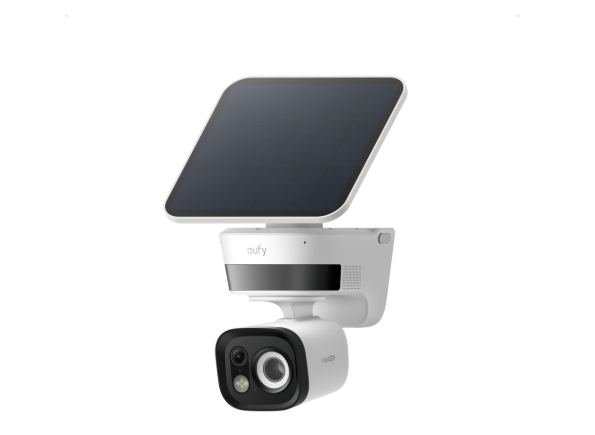
When a fixed wide-angle view cannot hold a long driveway’s sideways movement, the eufy TrackLight Cam S1 brings pan-tilt movement and automatic tracking into that decision. Its single 4K PTZ camera rotates horizontally up to 355° and tilts vertically up to 75°, while up to 10x zoom helps capture detail farther down the driveway. The camera also supports automatic tracking that keeps a moving subject framed, although the useful result still depends on the starting view, obstacles, and the path being monitored.
The S1 uses dual radar detection with customizable zones for more targeted alerts around an entrance, parking area, or walking path. Its focused light and siren can respond when the camera detects suspicious activity, and color night vision helps the camera continue working after dark. Solar power and a built-in battery support outdoor placement where running a cable to the far end of a driveway would be difficult. It is a candidate for a wide, open property where movement crosses the fixed view, not a reason to replace every fixed camera.
Conclusion
Fixed and pan-tilt cameras solve different coverage problems. A fixed camera keeps a dependable view of one zone and works well when the route is compact or when several areas need continuous monitoring. A pan-tilt camera adds movement for properties where a person or vehicle crosses a broad space and leaves a fixed frame. Start with the driveway shape. Mark the points where a subject enters, crosses, and stops, then decide whether you value a stable view of each area or tracking across one larger route. The right design is the one whose blind spots and tracking limits match your property.