John Gottman: Inside the Research Behind Lasting Relationships
Meet the psychologist behind the Love Lab, the Four Horsemen, decades of couples research, and one of the best-known approaches to relationship therapy.

Introduction
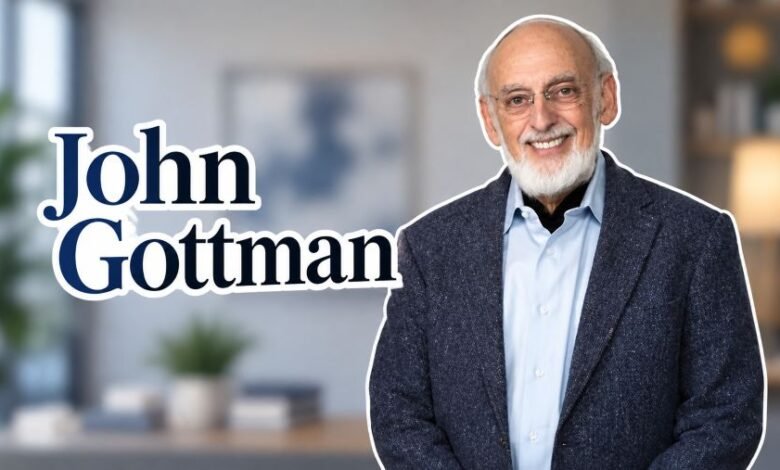
John Gottman is an American psychologist, researcher and author known for studying how couples communicate, handle conflict and stay connected.
His work goes back decades. A lot of it was hands-on too. Couples were observed talking, arguing and spending time together while researchers recorded behaviour and physical responses such as heart rate.
That research became strongly linked with the Love Lab, the Four Horsemen, the idea of bids for connection, and later the Gottman Method.
As of September 2026, Gottman is Professor Emeritus of Psychology at the University of Washington and co-founder of The Gottman Institute. His official profile credits him with more than 250 academic articles and over 50 books.
John Gottman Quick Facts
| Fact | Detail |
|---|---|
| Full name | John Mordechai Gottman |
| Born | April 26, 1942 |
| Birthplace | Dominican Republic |
| Profession | Psychologist, researcher and author |
| Main field | Relationships, marriage and couples research |
| University role | Professor Emeritus, University of Washington |
| Known for | Love Lab, Four Horsemen and relationship research |
| Organisation | Co-founder of The Gottman Institute |
| Spouse | Dr. Julie Schwartz Gottman |
| Education | Fairleigh Dickinson University, MIT and University of Wisconsin–Madison |
| Major book | The Seven Principles for Making Marriage Work |
His birth date and early background are reported by academic reference sources, while his education and professional history are also documented by the University of Wisconsin–Madison.
Who Is John Gottman?
John Gottman studies relationships.
Simple as that.
What made his work stand out was the way he tried to measure what actually happened between couples rather than relying only on what people later remembered about an argument.
Researchers watched interactions.
They coded emotions.
They tracked physical reactions.
Then they followed couples over time.
This approach helped Gottman and his colleagues identify communication patterns associated with relationship satisfaction and, in some studies, later separation or divorce.
His research later moved beyond university papers. Together with his wife, clinical psychologist Julie Schwartz Gottman, he helped turn many research findings into therapy methods, workshops and relationship education.
Early Life and Education
Gottman was born in the Dominican Republic in 1942.
He has publicly explained that his parents were Viennese refugees who fled Austria as Nazi persecution grew in Europe. The family later moved to the United States.
Interestingly, psychology was not his only academic interest.
Math came first.
Gottman earned a bachelor’s degree in Mathematics–Physics from Fairleigh Dickinson University in 1962.
He then studied at the Massachusetts Institute of Technology, earning a master’s degree combining mathematics and psychology in 1964.
Next came the University of Wisconsin–Madison.
He received an M.A. in clinical psychology–mathematics in 1967 and a PhD in clinical psychology in 1971.
That mix matters.
His mathematical background later became part of the way he studied sequences in couple behaviour, rather than treating relationship conflict as something too messy to measure.
How John Gottman’s Career Started
After earning his doctorate, Gottman held academic positions at Indiana University and the University of Illinois.
He joined the University of Washington Department of Psychology in 1986.
His relationship research had already started years earlier.
During the 1970s, he and other researchers were trying to figure out whether patterns inside everyday couple interactions could be identified and measured.
Could certain behaviours appear again and again?
Could researchers separate happier couples from distressed ones?
Could early interaction patterns tell researchers something about what happened years later?
Those became major questions in his career.
John Gottman and Robert Levenson’s Research
Psychologist Robert Levenson became one of Gottman’s most important research collaborators.
Their studies went beyond listening to what couples said.
The researchers recorded physiological signals while partners talked, including measures linked with heart rate, movement and arousal.
Gottman later explained in an American Psychological Association interview that the research used equipment to synchronise video recordings with physical measurements from both partners.
A 1992 peer-reviewed Gottman and Levenson study examined 73 married couples and looked at behaviour, physiology, health and later relationship dissolution.
This mix of observation and long-term follow-up became a major part of Gottman’s research identity.
What Is John Gottman’s Love Lab?
The Love Lab is the popular name associated with Gottman’s relationship research laboratory at the University of Washington.
It was built to look more like normal living space than a cold research room.
Couples could spend time together while researchers studied how they interacted.
Small moments mattered.
A comment.
A look.
An ignored question.
A tense argument.
Even the way one partner responded when the other tried to get their attention could become useful research data.
Gottman’s current official profile says he founded the Love Lab at the University of Washington, where much of his research into couples’ interactions took place.
What Are Gottman’s Four Horsemen?
One of Gottman’s best-known ideas is the Four Horsemen.
They describe four communication behaviours linked with serious relationship trouble:
Criticism attacks a partner’s character rather than discussing a specific problem.
Contempt can include mockery, ridicule, insults or communicating superiority.
Defensiveness often appears when someone responds to criticism by denying responsibility or immediately blaming the other person.
Stonewalling happens when someone shuts down or withdraws from the interaction.
Contempt gets particular attention in Gottman’s work.
During an APA interview, he described contempt as especially damaging among the four behaviours and discussed findings linking it with relationship breakdown.
The Four Horsemen are now among the most widely recognised ideas associated with Gottman’s public work.
What Are Bids for Connection?
A bid for connection can be very small.
“Look at that.”
“Listen to this.”
“How was your day?”
Want some tea?
The words themselves may seem ordinary.
The important part is that one person is asking, directly or indirectly, for attention or connection.
A partner can respond by turning toward the bid, ignoring it or reacting negatively.
Gottman has said that researchers became interested in these tiny moments while observing couples inside the Love Lab.
In the APA’s 2024 interview, he described researchers noticing partners making simple attempts to get each other’s interest or attention during ordinary time together.
That helped make small daily interactions a major part of Gottman’s public relationship advice.
Gottman Method Couples Therapy
John Gottman’s research eventually became connected with clinical work through his partnership with Dr. Julie Schwartz Gottman.
Julie brought extensive clinical psychology experience.
John brought decades of research data.
The two started turning findings from successful and distressed couples into interventions therapists could actually use.
That work became the Gottman Method Couples Therapy system.
The wider model includes ideas around friendship, conflict management, shared meaning, trust, commitment and emotional connection.
The Gottman Institute says its current method grew out of years of mathematical, observational and clinical research. Research linked with the Institute continues today.
John and Julie Gottman
John Gottman’s professional story is closely connected with Julie Schwartz Gottman.
According to Julie’s account in an American Psychological Association interview, they met in 1986 and married in 1987.
Their backgrounds were different.
That became useful.
John had spent years studying couples as a researcher. Julie had direct experience as a practicing clinical psychologist.
During the early 1990s, they started working together on ways to turn the research into practical relationship interventions.
They later co-founded The Gottman Institute.
Their partnership has produced books, therapy training, workshops and educational resources for couples.
The Sound Relationship House
Another major idea linked with John and Julie Gottman is the Sound Relationship House.
Think of it as a way to organise different parts of a healthy relationship.
Their work looks at areas such as knowing a partner’s inner world, showing appreciation, responding to bids, handling conflict, supporting personal goals, creating shared meaning, building trust and maintaining commitment.
The model grew from attempts to understand what couples who remained satisfied seemed to do differently from distressed couples.
Julie Gottman discussed the development of the model during the APA interview, explaining that the pair began analysing successful couples and creating interventions based on those findings.
Can John Gottman Really Predict Divorce?
This needs a careful answer.
Some Gottman studies reported high rates when classifying relationship outcomes inside specific research samples. That does not mean anyone can watch any couple and predict their divorce with 90% accuracy.
That distinction matters.
Gottman and Levenson’s research found measurable differences in interaction patterns connected with later relationship outcomes. Some published prediction studies produced striking classification results.
But researchers Richard Heyman and Amy Smith Slep later warned that divorce-prediction equations need independent cross-validation.
Why?
A model can fit the original group very well and still perform much worse when tested on completely different people.
Their peer-reviewed analysis found that prediction performance fell substantially during cross-validation and argued that strong initial results should be treated cautiously when they have not been independently tested.
So the safe answer is clear.
Gottman’s work found relationship patterns associated with later outcomes.
It did not create a guaranteed divorce detector.
John Gottman’s Books
Writing helped take Gottman’s academic work to a much wider audience.
His official profile now credits him with more than 50 books and over 250 published academic articles.
Some of his best-known books include:
- The Seven Principles for Making Marriage Work
- Why Marriages Succeed or Fail
- The Relationship Cure
- The Science of Trust
- What Makes Love Last?
- Raising an Emotionally Intelligent Child
- Eight Dates
- The Love Prescription
- Fight Right
He has written some books alone and others with writers, researchers or Julie Gottman.
Fight Right, written by John and Julie Gottman, was published in 2024 and focuses on how couples handle conflict.
Awards and Recognition
Gottman’s official profile lists a number of professional honours earned across his research career.
They include four National Institute of Mental Health Research Scientist Awards, the American Association for Marriage and Family Therapy Distinguished Research Scientist Award, and a Presidential Citation for Outstanding Lifetime Research Contribution from the American Psychological Association’s family psychology division.
He also received the 1994 Burgess Award from the National Council on Family Relations.
In 2021, the University of Wisconsin–Madison awarded him an honorary doctorate and invited him to speak at its spring commencement.
What Is John Gottman Doing Now?
John Gottman remains publicly active.
As of September 2026, The Gottman Institute still identifies him as Professor Emeritus of Psychology at the University of Washington and co-founder of both The Gottman Institute and Affective Software.
Research connected with the Gottman organisation also continues, with Research Director Dr. Carrie Cole working with John and Julie Gottman on current research projects.
There is another clear sign that he remains professionally active.
John and Julie Gottman are scheduled to host a live virtual Art & Science of Love workshop on December 3–4, 2026.
Why John Gottman’s Work Became So Well Known
Relationships are hard to measure.
People remember arguments differently.
They tell different stories.
And couples do not always behave in a therapist’s office the same way they behave at home.
Gottman’s research tried to get closer to what was actually happening.
Watch the interaction.
Measure physical responses.
Code the behaviour.
Follow the couple.
Check what happened later.
That approach helped bring observational and quantitative methods into public conversations about marriage and relationships.
Still, research findings need context.
They are patterns, not fortune-telling.
That distinction makes the work more useful, not less.
Final Thought
John Gottman’s career sits somewhere between mathematics, psychology and everyday human relationships.
He started with numbers.
Then he studied couples.
Over decades, his work examined arguments, affection, stress, attention, trust and those tiny moments people usually forget five minutes later.
Some of his ideas became household relationship terms. The Four Horsemen are one example. Bids for connection are another.
His research has also attracted academic debate, especially around claims about predicting divorce. That debate deserves to stay in the story.
The strongest way to understand Gottman’s work is not as a promise that relationships can be reduced to a formula.
It is simpler.
Careful observation can show patterns.
And those patterns can help researchers ask better questions about why some relationships hold together while others struggle.
Frequently Asked Questions
Who is John Gottman?
John Gottman is an American psychologist, researcher and author known for decades of research into marriage, relationships and couple communication.
What is John Gottman famous for?
He is widely known for the Love Lab, the Four Horsemen framework, research into relationship stability, and work that helped form the Gottman Method.
Is John Gottman still working?
Yes. As of September 2026, he remains professionally active and is scheduled with Julie Gottman to host a virtual Art & Science of Love workshop in December 2026.
Is John Gottman a professor?
He is Professor Emeritus of Psychology at the University of Washington.
Who is John Gottman’s wife?
His wife is clinical psychologist Dr. Julie Schwartz Gottman, his longtime research and professional collaborator. They met in 1986 and married in 1987.
What are John Gottman’s Four Horsemen?
They are criticism, contempt, defensiveness and stonewalling—four negative communication patterns associated with troubled relationship interaction.
Can John Gottman predict divorce with 90% accuracy?
Some studies reported high classification rates in particular samples, but researchers have warned against treating those findings as a universal prediction tool without independent cross-validation.
What is John Gottman’s most famous book?
The Seven Principles for Making Marriage Work is one of his best-known books and has become closely associated with his public relationship work.