Zoe Kleinman: The Journalist Explaining AI at the BBC
From early BBC production work to becoming the broadcaster’s first Technology Editor, Zoe Kleinman has built a career explaining AI, cybersecurity, social media and Big Tech in plain language.

Introduction
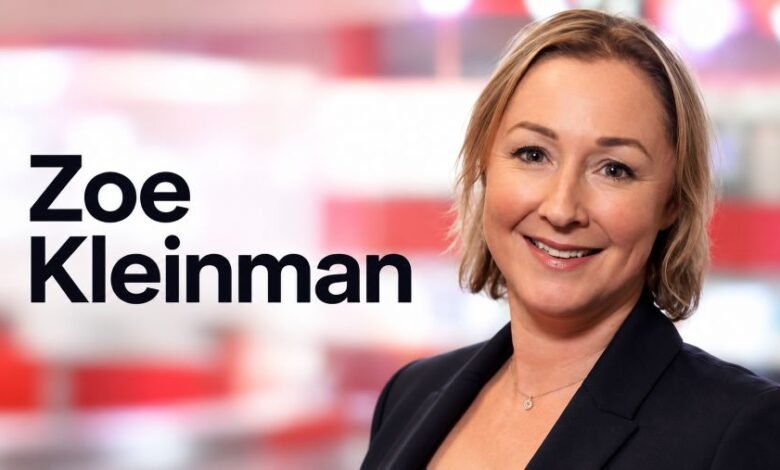
Zoe Kleinman is a British technology journalist and broadcaster best known for her work with BBC News. She became the BBC’s first Technology Editor in 2021, after years of reporting on technology for the broadcaster.
Her beat is broad. Very broad.
She reports on artificial intelligence, cybersecurity, social media, cryptocurrency, online safety, consumer technology and major technology companies. Her work appears across BBC television, radio and online platforms.
Right now, AI is a major part of her reporting.
Zoe Kleinman Quick Facts
| Fact | Detail |
|---|---|
| Full Name | Zoe Kleinman |
| Profession | Technology journalist and broadcaster |
| Known For | BBC technology reporting |
| Current Role | BBC Technology Editor |
| Employer | BBC |
| Appointed Technology Editor | 2021 |
| Education | BA in English |
| University | University of Southampton |
| Graduation Year | 1998 |
| Main Topics | AI, cybersecurity, social media, online safety, Big Tech and cryptocurrency |
| BBC Career | More than two decades |
| Public Work | Journalism, broadcasting, presenting and conference moderation |
Who Is Zoe Kleinman?
Zoe Kleinman is one of the BBC’s main journalists covering technology.
Her job sounds simple on paper. Technology rarely is.
She takes subjects such as generative AI, data privacy, hacking, social networks and digital regulation, then explains what they mean for ordinary people.
That matters because tech stories can quickly become technical. Kleinman’s BBC reporting is usually built around a much simpler question: what does this change mean for people using these products or services?
Her work has taken her from consumer gadgets to some of the biggest debates around AI.
Zoe Kleinman’s Education
Kleinman studied English at the University of Southampton.
She graduated with a BA in English in 1998.
Journalism was already on her mind.
While studying, she worked as the features editor of the university student newspaper. She also gained experience in a university press office during academic breaks.
That gave her practical writing experience.
She has publicly recalled wanting to become a journalist from a young age. She also remembers using a BBC Micro computer as a child, experimenting with simple coding and playing games.
Technology came early, basically.
Journalism followed later.
Her Early Journalism Career
Kleinman did some local newspaper work before taking on public-relations work connected with the university.
Part of that job involved writing about academic research for the media.
Still, she wanted journalism.
She later joined the BBC.
Professional records place her BBC career from 2003. One of her earlier jobs was working as features editor for Ariel, the BBC’s former staff publication.
She then worked as a web producer on the BBC Two business programme Working Lunch.
Those roles were mostly behind the scenes.
That changed.
Moving Into Technology Reporting
By around 2009, Kleinman had moved into senior technology reporting.
The timing was interesting.
Smartphones were changing daily life. Social networks were growing quickly. Apps were becoming normal. Cloud services were spreading. Online privacy was becoming a much bigger public issue.
Kleinman reported through much of that change.
Her coverage came to include:
- Artificial intelligence
- Cybersecurity
- Social media
- Online privacy
- Consumer technology
- Gaming
- Cryptocurrency
- Robotics
- Driverless vehicles
- Technology regulation
- Major technology companies
She also began appearing more often across BBC radio and television.
Becoming BBC Technology Editor
A major career change came in 2021.
BBC News appointed Zoe Kleinman as its first Technology Editor.
She had already spent years covering the sector, so the appointment moved her into a wider editorial role across BBC News.
The position involves reporting on major technology stories for television, radio and digital audiences.
Her reporting has since become closely linked with the growth of artificial intelligence.
And AI stories have come thick and fast.
Zoe Kleinman and Artificial Intelligence Reporting
Artificial intelligence is now one of Kleinman’s main reporting areas.
She covered the UK government’s AI Safety Summit at Bletchley Park in 2023, an event that brought political leaders, researchers and major technology companies together to discuss AI risks and safety.
She later covered the AI Action Summit in Paris in 2025.
Her AI reporting looks at several questions.
Who controls powerful AI systems?
How safe are they?
What happens to jobs?
How should governments regulate them?
What happens to copyrighted work used to train AI?
These are tough subjects. Kleinman reports on them for a broad BBC audience rather than only for technology specialists.
Major Technology Stories
Kleinman’s career has covered far more than AI.
She reported on the Facebook-Cambridge Analytica scandal, which raised major questions about political campaigning, personal data and social-media privacy.
Her reporting has also covered cryptocurrency.
Then came gaming.
One strand of her work looked at children spending large amounts of money through purchases inside mobile and online games. The wider issue later became part of political discussion around gaming, consumer protection and gambling-style mechanics.
She has also reported on Elon Musk’s takeover of Twitter, now X, workplace issues in Silicon Valley, online safety and the actions of major tech firms.
Interviews With Major Technology Leaders
Technology journalism often means talking directly with the people running large companies.
Kleinman has interviewed senior figures including:
- Tim Cook of Apple
- Satya Nadella of Microsoft
- Jensen Huang of Nvidia
- Sir Demis Hassabis of Google DeepMind
She also interviewed then UK Prime Minister Rishi Sunak during coverage linked with the 2023 AI Safety Summit.
These interviews fit naturally into her BBC role.
She reports on companies making technology.
Then she asks their leaders what comes next.
BBC Radio and Presenting Work
Kleinman’s work is not limited to written journalism.
She has appeared across BBC television and radio and has worked with the BBC World Service.
Her presenting work has included technology and business programming such as Tech Tent.
She has also presented BBC Radio 4’s PM.
So her career sits across several formats: reporting, writing, presenting, interviewing and live event moderation.
Reporting During the COVID-19 Pandemic
Her beat temporarily changed during the COVID-19 pandemic.
In March 2020, the BBC moved Kleinman from technology reporting into its health reporting team as demand for coronavirus coverage grew.
She later discussed that period with the University of Southampton.
It was a sharp change.
Tech reporting stopped being her main daily task for a time, and pandemic reporting took priority.
She later returned to technology journalism.
Zoe Kleinman’s Current Work
As of September 2026, Kleinman continues to be publicly identified as the BBC Technology Editor.
Some professional listings now use the wording Technology and AI Editor or Tech & AI Editor, which reflects how central artificial intelligence has become to her work.
She remained active at major technology and science events during 2026.
She appeared at London Tech Week 2026 and took part in the EBU AI Forum 2026, where she moderated discussion around AI, media and public trust.
In September 2026, she interviewed computer scientist Dame Wendy Hall during the British Science Festival hosted by the University of Southampton.
So, yes, her original university still crosses paths with her professional work.
Zoe Kleinman’s Personal Life
Kleinman has publicly described herself as a mother of three and a military wife.
She has spoken about balancing family life with the unusual demands of technology journalism.
She has also publicly discussed being pregnant around the time she was offered the BBC Technology Editor role in 2021.
The BBC appointment went ahead, and she later returned to the role.
Reliable public sources do not clearly establish her exact date of birth.
For that reason, claims about her exact age should be treated carefully.
The same rule applies to her husband’s name, personal finances and similar private details unless stronger public documentation appears.
Zoe Kleinman’s Salary and Net Worth
There is no strong public documentation establishing Zoe Kleinman’s personal net worth.
Generic celebrity wealth websites may publish estimates, but those figures do not provide enough evidence to treat them as fact.
Her exact BBC salary is also not reliably established through the sources used for this profile.
So guessing would add nothing useful.
Better to leave it there.
Interesting Facts About Zoe Kleinman
Kleinman has tested technology in some unusual settings.
She has raced drones in the Nevada desert.
She has ridden in a driverless vehicle.
She has experienced virtual reality designed to simulate climbing Mount Everest.
She also spent 48 hours attempting to live using Bitcoin on the Isle of Man.
These were not random stunts. They were ways to test technologies she was reporting on.
She also remembers using a BBC Micro computer while growing up, long before technology journalism became her career.
Why Zoe Kleinman Is Known
Kleinman is known because she sits between complicated technology and a general news audience.
AI models can be technical.
Cybersecurity can be technical.
Crypto certainly can.
Her BBC role requires her to take those stories and explain why they matter without assuming the audience works in technology.
That is basically the job.
And it has become a busy one.
As AI companies, governments and regulators debate what should happen next, technology journalism now covers business, politics, law, education, jobs and everyday consumer life at the same time.
Kleinman reports from the middle of those discussions.
Final Thought
Zoe Kleinman’s career did not start with artificial intelligence or high-profile technology interviews.
It started with writing.
She studied English, worked on a student newspaper, gained press-office experience, joined the BBC and gradually moved into technology reporting.
In 2021, she became the BBC’s first Technology Editor.
Today, much of her work centres on AI, cybersecurity, Big Tech and the rules being written around technology.
The tools keep changing.
Her basic task stays simple: find out what is happening, ask direct questions and explain it clearly.
Frequently Asked Questions
Who is Zoe Kleinman?
Zoe Kleinman is a British technology journalist and broadcaster. She is best known as the BBC’s Technology Editor.
What does Zoe Kleinman do at the BBC?
She reports on technology stories including artificial intelligence, cybersecurity, social media, online safety, cryptocurrency and major technology companies.
When did Zoe Kleinman become BBC Technology Editor?
She was appointed the BBC’s first Technology Editor in 2021.
Where did Zoe Kleinman study?
She studied at the University of Southampton.
What degree does Zoe Kleinman have?
She earned a BA in English, graduating in 1998.
Does Zoe Kleinman report on AI?
Yes. Artificial intelligence is now one of her main reporting areas. She has covered major international AI summits and interviews with technology leaders.
Is Zoe Kleinman married?
She has publicly described herself as a military wife. Strong public sources used for this profile do not clearly establish her husband’s identity.
Does Zoe Kleinman have children?
Yes. She has publicly described herself as a mother of three.
What is Zoe Kleinman’s net worth?
There is no reliable public financial documentation supporting a specific Zoe Kleinman net-worth figure.