Kathryn Yusoff Biography: 10 Powerful Career Facts
Discover her education, geography career, major books, research ideas, awards and influence on modern environmental thought.

Introduction
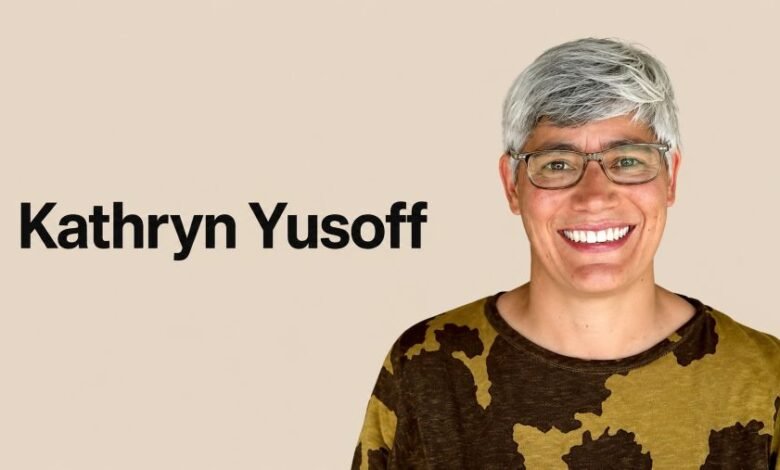
Kathryn Yusoff is a geographer, university professor, researcher and author known for exploring the links between geology, colonialism, race and environmental change.
She is Professor of Inhuman Geography and Director of Graduate Studies at Queen Mary University of London.
Her work questions the belief that geology is only a neutral study of rocks and the Earth. She examines how geological surveys, classification and resource extraction became connected with colonial power and racial inequality.
Yusoff is best known for writing A Billion Black Anthropocenes or None and Geologic Life: Inhuman Intimacies and the Geophysics of Race.
Her career is an important addition to collections of carefully researched academic biographies covering influential scholars and public thinkers.
Kathryn Yusoff Quick Bio
| Detail | Information |
|---|---|
| Full name | Kathryn Yusoff |
| Professional title | Professor Kathryn Yusoff |
| Gender | Female |
| Pronouns | She/her |
| Profession | Geographer, professor, author, researcher and curator |
| Current position | Professor of Inhuman Geography |
| Additional role | Director of Graduate Studies |
| Institution | Queen Mary University of London |
| Main fields | Geography, environmental humanities and critical theory |
| Known for | Research connecting geology, race, colonialism and extraction |
| PhD subject | Geography |
| PhD institution | Royal Holloway, University of London |
| Major books | A Billion Black Anthropocenes or None and Geologic Life |
| Major honour | 2022 AAG Stanley Brunn Award for Creativity in Geography |
Who Is Kathryn Yusoff?
Kathryn Yusoff is a transdisciplinary geographer whose research crosses human geography, physical geography, environmental studies, philosophy, history and the arts.
She describes her specialist field as inhuman geography.
This field examines the relationship between people and parts of the Earth that are normally described as nonhuman or without life, including rocks, minerals, soil and geological formations.
According to her official Queen Mary University profile, her research explores earthly relations, environmental change, racialisation and the continuing effects of colonialism.
Why Kathryn Yusoff Is Famous
Yusoff became internationally recognised for challenging common explanations of the Anthropocene.
The Anthropocene is a term used to describe a period in which human activity has significantly changed the Earth’s climate and environment.
However, Yusoff argues that environmental responsibility cannot be shared equally across all people and communities.
Her research places colonialism, slavery, mining and racial inequality at the centre of environmental history.
She studies how geological knowledge helped colonial governments identify valuable land, control natural resources and support systems of extraction.
This approach has made her influential across geography, Black studies, environmental humanities, architecture and decolonial scholarship.
Education and Artistic Training
Yusoff’s education brought together art, visual culture and geography.
She initially trained as a sculptor at Northumbria University.
This artistic background later influenced the way she approached landscapes, visual evidence, environmental knowledge and public exhibitions.
She continued her education with postgraduate study in visual cultures at Bath Spa University.
Her early academic interests included history, philosophy, art and the ways people represent places through images.
She later moved into geography and completed doctoral research through the University of London at Royal Holloway.
PhD and Antarctic Research
Yusoff completed her PhD in Geography in 2005.
Her doctoral thesis was titled Arresting Vision: A Geographical Theory of Antarctic Light.
The project examined Antarctica through light, vision, photography, time and geographical knowledge.
Her research asked how people understand an extreme environment when ordinary ideas about day, night, distance and visibility do not always apply.
This early work also considered the physical body and the senses.
Yusoff questioned whether looking at a landscape from a distance could provide a complete understanding of that place.
Her Antarctic studies formed the foundation for her later research into climate change, environmental knowledge and political power.
Early Career and Intellectual Development
Yusoff’s early published work concentrated on Antarctica, polar environments and the visual representation of climate change.
She examined how explorers, photographers, scientists and governments created particular images of the polar regions.
These images could present Antarctica as an empty wilderness, a scientific laboratory or an early warning sign of climate change.
Her academic direction later changed as she began studying the political histories behind environmental vulnerability.
She became interested in why racialised and colonised communities often experienced severe environmental damage while remaining overlooked within mainstream climate discussions.
This became an important turning point in her career.
It moved her research towards colonial geology, resource extraction, racialisation and environmental justice.
Academic Career
Before joining Queen Mary University of London, Yusoff held academic positions at Lancaster University and the University of Exeter.
These roles allowed her to develop work across geography, climate change, visual culture and environmental theory.
She later joined Queen Mary and progressed through senior research and teaching positions.
Yusoff became Professor of Inhuman Geography and also took responsibility for postgraduate development as Director of Graduate Studies.
Her university work includes research, teaching, doctoral supervision, academic leadership and international collaboration.
Readers interested in another university career addressing social harm can explore this profile covering victimology and criminology research.
What Does Inhuman Geography Mean?
Inhuman geography studies how human society interacts with the material Earth.
Yusoff uses the word “inhuman” in more than one way.
It can describe cruel or unequal political actions that expose certain communities to environmental danger.
It can also describe rocks, minerals and other forms of matter that are normally placed outside human social life.
Yusoff argues that Western political and scientific traditions have often separated people from the Earth.
Once land and geological matter are treated as lifeless objects, they can be measured, owned and extracted without considering wider relationships or consequences.
Her work attempts to reconnect social history with geological history.
A Billion Black Anthropocenes or None
Yusoff published A Billion Black Anthropocenes or None through the University of Minnesota Press in 2018.
The book became her breakthrough publication.
It argues that popular stories about the Anthropocene often describe environmental destruction as a recent problem created by humanity as a whole.
Yusoff instead draws attention to the much longer histories of slavery, colonisation, plantations, mining and racial violence.
She explains that some communities experienced destructive environmental change long before climate change became a major international political issue.
The book connects Black feminist theory, geography and Earth science.
It also argues that geological language helped support colonial economies by classifying land and matter as resources available for extraction.
Geologic Life
Yusoff published Geologic Life: Inhuman Intimacies and the Geophysics of Race in 2024.
The book studies the history of geology and its relationship with colonial expansion, racial classification and mineral extraction.
According to Duke University Press, the work examines how imperial geology became embedded in Western thought and contributed to environmental injustices affecting Black, Indigenous and Brown communities.
Yusoff explores geological practices such as surveying, identifying, classifying, valuing and extracting.
She argues that these practices did more than create scientific knowledge.
They also influenced the way colonial governments understood land, human populations and economic value.
The book draws attention to Black, Indigenous and Caribbean ideas that offer different ways of understanding relationships with the Earth.
Main Research Themes
A central theme in Yusoff’s work is the relationship between knowledge and power.
She studies how scientific maps, surveys and classification systems can change both landscapes and communities.
Another major subject is environmental justice.
Her research asks why communities that contributed least to environmental damage often experience some of its most serious effects.
Yusoff also researches climate change, materiality, extinction, biodiversity loss, geology, colonial history and political aesthetics.
Her work connects specialist academic theory with questions that affect public life.
This practical connection between university research and social inequality is also seen in scholarship about workplace diversity and leadership research.
Awards and Professional Recognition
Yusoff received the Stanley Brunn Award for Creativity in Geography from the American Association of Geographers in 2022.
The award recognised the originality of her work across feminist philosophy, critical geography, art and Earth science.
It is presented to geographers whose research demonstrates creativity and important intellectual development.
Her work has also been included in academic discussions of influential thinkers on space, place and environmental theory.
Her books are now studied across geography, environmental humanities, cultural theory, architecture and Black studies.
Art, Film and Curatorial Work
Yusoff’s career is not limited to academic books and university teaching.
She has contributed to exhibitions, films and creative projects connecting art with environmental research.
Her earlier curatorial work included POLAR: The Art and Science of Climate Change.
The project examined how knowledge about climate change in the polar regions is produced and communicated.
She was also involved with Weather Permitting, a collaborative group exploring connections between art, weather and environmental science.
Yusoff appeared as the Time Traveller in the Otolith Group’s film and installation INFINITY MINUS INFINITY.
The project used her ideas about geology, Black history and environmental time.
British Pavilion at the Venice Biennale
Yusoff was part of the curatorial team representing the British Pavilion at the 2025 Venice Architecture Biennale.
She worked with Kabage Karanja, Stella Mutegi and Owen Hopkins.
Their exhibition was titled GBR – Geology of Britannic Repair.
The United Kingdom and Kenya collaboration examined how architecture, geology and colonial extraction are connected.
It also considered the meaning of repair, restitution and renewal after long histories of environmental and cultural damage.
The exhibition received a Special Mention for National Participation from the Biennale jury.
This recognition belonged to the complete collaborative project and its curatorial team.
Public Philosophy and Values
Yusoff believes environmental politics must address the histories of colonialism and racial inequality.
She argues that climate discussions become incomplete when they focus only on emissions, technology and future targets.
Her work asks people to consider who experienced earlier forms of environmental violence and who continues to carry their effects.
She also develops the idea of inhuman reparations.
This concept explores how environmental repair could respond to damage caused by colonial extraction and unequal development.
Her approach shares a wider concern for justice and human values with scholarship examining ethics, law and artificial intelligence.
Artificial Intelligence and Environmental Extraction
Yusoff’s recent work connects artificial intelligence with environmental and colonial histories.
Digital technology may appear separate from the natural world, but AI systems require large amounts of electricity, water, minerals and physical infrastructure.
Data centres and electronic devices depend on resources extracted from real landscapes.
Yusoff examines whether modern digital systems continue older patterns in which resources are removed from African and other Global South communities for the benefit of wealthier economies.
Her research also considers whose languages, histories and knowledge are represented within artificial intelligence systems.
Public Image
Yusoff’s public image is mainly intellectual, academic and research-focused.
She is known for using interdisciplinary methods and connecting subjects that are often studied separately.
Her work combines geography with philosophy, Black studies, art, architecture and environmental history.
She regularly appears through university lectures, research events, interviews and cultural exhibitions.
Unlike an entertainment celebrity, her public profile is based on books, academic ideas and collaborative projects.
Current Status
As of June 2026, Yusoff continues to work as Professor of Inhuman Geography and Director of Graduate Studies at Queen Mary University of London.
Her current research covers colonial environmental histories, race, extraction, artificial intelligence and different forms of planetary repair.
In March 2026, Queen Mary highlighted her involvement in an international exhibition examining artificial intelligence and questions of human agency.
She also delivered a public lecture titled Inhuman Reparations in Amsterdam in May 2026.
Her recent work continues the ideas developed through Geologic Life and the British Pavilion at the Venice Biennale.
10 Interesting Facts About Kathryn Yusoff
- She trained as a sculptor before becoming a geographer.
- She completed postgraduate study in visual cultures.
- Her PhD research examined Antarctic light and vision.
- She previously worked at Lancaster University and the University of Exeter.
- She is Professor of Inhuman Geography at Queen Mary University.
- She wrote A Billion Black Anthropocenes or None.
- Her major book Geologic Life was published in 2024.
- She received an American Association of Geographers award in 2022.
- She co-curated the British Pavilion at the 2025 Venice Architecture Biennale.
- Her recent research examines the environmental resources required by artificial intelligence.
Frequently Asked Questions
Who is Kathryn Yusoff?
She is a geographer, professor and author known for connecting geology with race, colonialism and environmental justice.
Where does Kathryn Yusoff work?
She works at Queen Mary University of London.
What is her current academic title?
She is Professor of Inhuman Geography and Director of Graduate Studies.
What did she study?
Her academic training includes sculpture, visual cultures and geography.
Where did she complete her PhD?
She completed her doctorate through the University of London at Royal Holloway.
What was her doctoral research about?
Her PhD examined Antarctic light, vision, photography and geographical knowledge.
What is Kathryn Yusoff’s most famous book?
She is widely recognised for A Billion Black Anthropocenes or None.
What award did she receive?
She received the 2022 Stanley Brunn Award for Creativity in Geography.
Conclusion
Kathryn Yusoff has built an original academic career by bringing geography into conversation with history, philosophy, art and environmental justice.
Her early work on Antarctica gradually developed into a wider examination of geology, colonialism and racial power.
Through her books, she has argued that environmental history cannot be separated from slavery, extraction and unequal ideas about people and land.
Her teaching, writing and curatorial projects continue to influence debates about climate change, architecture, artificial intelligence and planetary repair.
Readers can discover more university careers through BlogMush’s collection of academic researcher profiles.